Industrial Buildings Reborn as Cultural Engines
News Detail
How transforming industrial structures cuts carbon, preserves heritage and powers cultural architecture
Curated by Juan A. Morillas – Share Your Green Design
Across the world, disused industrial buildings are becoming important assets for a climate responsible built environment and the life of cities. A new cultural architecture is emerging not from clean slates but from the raw and generous shells of industry.
For more than a century, industry shaped entire districts and even the identities of cities. Rail lines, mills, power stations, shipyards and manufacturing belts drew workers, generated economies and produced the urban landscapes we inherited. As production shifted, first to the edges of cities, then offshore and now into cleaner, smaller scale or digital forms, these once central structures became obsolete almost overnight. Energy systems changed, heavy industry left and the robust buildings that powered urban growth were abandoned.
Their obsolescence is not an ending. These industrial structures are spatial assets with a second life. They offer generous volumes, durable materials and valuable urban footprints that can be re embedded in contemporary life. When adapted with intelligence, they reconnect past and present. They also preserve economic value already invested in the original fabric and support new forms of culture, public life and sustainable innovation.
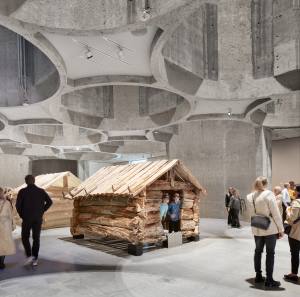 Photo by Alan Williams
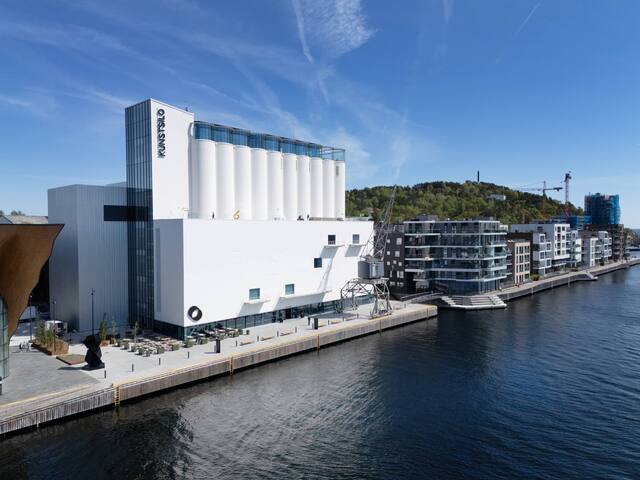
Kunstsilo – Project
𝗞𝘂𝗻𝘀𝘁𝘀𝗶𝗹𝗼 (Norway) – Mestres Wåge Arquitectes, Mendoza Partida, BAX Studio.
Why Reuse Matters
Retaining heavy masonry or concrete walls, steel trusses and robust frames avoids the massive embodied ecological impact of manufacturing new materials. It also eliminates demolition waste. Transformation keeps existing materials in circulation, reducing upfront carbon and preventing resource extraction. These structures carry cultural memory and industrial intelligence. The patina of labour, the spatial logic of production and the material character that gives a place its identity all remain active ingredients in their future.
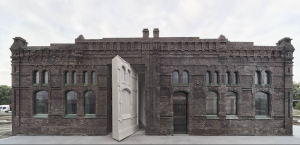 Photo by Juliusz Sokołowski, Jakub Certowicz, Viktoria Tymanova, Ostrava City archive, KWK Promes
PLATO Contemporary Art Gallery – KWK Promes.
Kunstsilo, Kristiansand — Mestres Wåge Arquitectes, BAX Studio, Mendoza Partida
Kunstsilo reimagines a 1930s functionalist grain silo on Kristiansand’s Odderøya peninsula, originally designed by Arne Korsmo and Sverre Aasland, into a major Nordic art museum. The renovation by Mestres Wåge Arquitectes, BAX Studio and Mendoza Partida retains the striking mass of thirty cylindrical concrete silos, preserving the expressive modernist structure and its industrial logic. The architects cut away sections of the cylinders to create a twenty‑one‑metre‑tall Silo Hall, revealing the monumental storage geometry that once held fifteen thousand tonnes of grain. By slicing, hollowing and exposing the cylinders, the design turns the industrial anatomy into spatial drama.
Retaining the concrete superstructure avoids demolition waste and reduces embodied carbon, while insulation, ventilation and lighting are introduced with restraint to achieve museum climate standards. On the waterfront, this transformation reuses existing infrastructure and gives the silo a civic role that exceeds its original industrial purpose, anchoring Kristiansand’s growing cultural district.
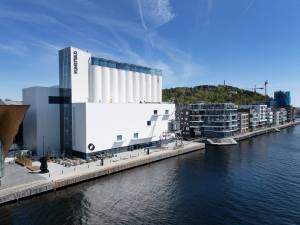 Photo by Alan Williams
PLATO Contemporary Art Gallery, Ostrava — KWK Promes (Robert Konieczny)
PLATO is a transformation of a historic municipal slaughterhouse by KWK Promes, led by Robert Konieczny. The renovation retains the weathered, soot‑darkened brick façades and battered openings that record the building’s heavy industrial past. Missing sections of the slaughterhouse are reconstructed in micro‑concrete, a contemporary material chosen to maintain visual continuity with the original masonry while clearly expressing new intervention.
The slaughterhouse’s former logistical openings inspire six rotating walls that allow the galleries to open directly to the exterior, reactivating the building’s original porosity in a new cultural form. The surrounding contaminated land has been remediated and converted into a biodiverse art park with permeable surfaces, meadows and retention basins. Salvaged bricks from demolished sections are reused inside and out, while lime‑plastered interiors integrate low‑carbon materials into the renewed structure. The project keeps industrial memory visible, turning a once‑derelict site into an open, democratic cultural landscape.
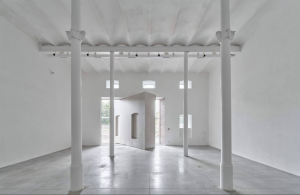 Photo by Juliusz Sokołowski, Jakub Certowicz, Viktoria Tymanova, Ostrava City archive, KWK Promes
Alembic Museum, Vadodara — Karan Grover & Associates
The Alembic Museum, designed by Karan Grover & Associates, occupies five factory sheds of the former Alembic Chemical Works, established in 1907 for the production of tinctures and alcohol. The sheds retain their historic brick walls, steel trusses and characteristic arched openings, many of which had been filled in over decades of industrial modification. The architects restore these elements by reopening arches where structurally safe, cleaning and preserving the exposed brickwork, and reinforcing the Mangalore‑tile roof while replacing damaged tiles selectively.
The interiors maintain their industrial character with unplastered lintel‑height partitions for artists’ studios, an unfinished aesthetic that acknowledges the building’s working past. Circulation and programme are organised around existing openings to avoid unnecessary structural intervention. Optimised daylight and natural ventilation reduce operational energy demand, creating a materially honest and low‑carbon transformation that preserves the identity and memory of early Indian industrial manufacturing.
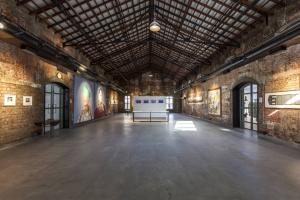 Photo by Ms. Esha Daftari
Lot 8, Le Magasin Électrique, Arles — Assemble + BC Architects & Studies + Atelier LUMA
Lot 8 is a collaborative transformation by Assemble, BC architects & studies and Atelier LUMA, set within a nineteenth‑century SNCF electrical warehouse and train depot. The existing industrial structure, with its steel trusses, masonry envelope and generous bays, becomes the framework for a new materials laboratory rooted in bioregional design.
The team preserves the building’s industrial identity while introducing a radical material palette developed from local resources: structural walls and partitions formed from waste earth and minerals, acoustic and interior panels made from sunflower fibres, rice straw and soil, and surfaces and fixtures originating from research into algae, salt, bioplastics and local sediments. This approach restores the depot as a site of production and experimentation, extending its industrial legacy through contemporary ecological craft. The former concrete yard has been reshaped into a public park with new planting, topography and a large pond that creates a microclimate and transforms the hardscape into civic ecology.
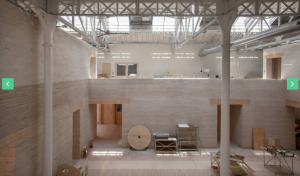 Photo by Adrian Deweerdt, Joseph Halligan, Joana Luz, Jean-Yves Demuyter, Victor&Simon/ Victor Picon Presse nationale & internationale, Oliver Querette/Ektadoc/Caméléon.
Lot 8 – Le Magasin Électrique – Project
TanArt Community, Xi’an — Nomos Architects
TanArt Community by Nomos Architects adapts a 1997 coal‑burning boiler station at Xi’an Shiyou University. Though relatively young, the structure had become obsolete following changes to the city’s heating system, leaving behind tall chimneys, large coal scuttles and a cavernous boiler hall typical of late‑industrial energy facilities. The architects preserve these distinctive elements as anchors of the new cultural programme, recognising their value as emerging industrial heritage.
A new elevated runway connects the public square to the upper exhibition hall, revealing the dramatic height of the original boiler space and articulating a clear dialogue between old structure and new intervention. The façade is reclad in polycarbonate panels, bringing soft, diffuse daylight into the once‑opaque industrial shell and improving thermal performance while maintaining the building’s massing. Inside, mechanical systems integrate into former production spaces, with old concrete and new stainless‑steel elements displayed side by side. The project protects the structural frame from subdivision and extends the life of a rare industrial typology that is rapidly disappearing across China.
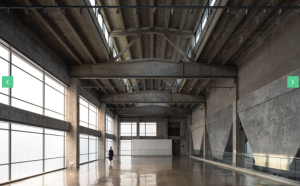 Photo by Studio Ten, Tan Xiao
Powerhouse Arts, Brooklyn — Herzog & de Meuron + PBDW Architects
Powerhouse Arts is designed by Herzog & de Meuron, with PBDW Architects as executive architect, and transforms the 1904 Brooklyn Rapid Transit Power Station into a contemporary vertical factory for art. The original building once supplied electricity to the city’s expanding rail network, and after its decommissioning in the 1950s it became a partial ruin, with half the structure demolished and the remaining Turbine Hall appropriated by graffiti artists and squatters, earning the nickname The Batcave. In the new project, the Turbine Hall’s brick masonry, steel trusses, glazed tiles and even graffiti layers are preserved and structurally reinforced, maintaining a deep connection to the industrial and social history of the site. The long‑lost Boiler House is rebuilt on its original foundations, restoring the relationship between the two volumes while enabling new workshop spaces.
The building sits on a previously contaminated Superfund site along the Gowanus Canal, and full remediation enabled the reuse of land that would otherwise remain derelict. Fabrication workshops for wood, metal, ceramics, textiles and print are stacked vertically around a central service spine, a contemporary interpretation of industrial efficiency that reduces building footprint. Mechanical systems are housed in raised roof bulkheads, ensuring flood resilience in a changing climate. Through careful retention of existing fabric and sensitive reconstruction, the project extends the industrial legacy of the neighbourhood while turning the former power station into a resilient hub for creative production.
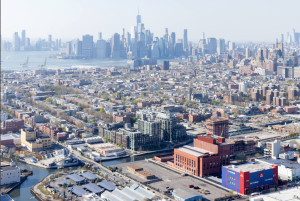 Photo by Albert Vecerka/ESTO