The future of steel reuse
News Detail

Year:
2026
Source:
Heyne Tillett SteelWritten by Tom Steel – Founding Director, Heyne Tillett Steel
It’s been five years since we undertook our first steel reuse project at Holbein Gardens for Grosvenor. Since then, HTS and the wider industry has embraced the technology with enthusiasm, resulting in numerous successfully delivered steel reuse projects. The process involves complex collaboration between engineers, contractors, subcontractors, architects and clients, resulting in real change and progress in low carbon engineering, which is a massive achievement.
So, now that the dust has settled – what have we learned? And what is the future for this technology?
Lessons learned
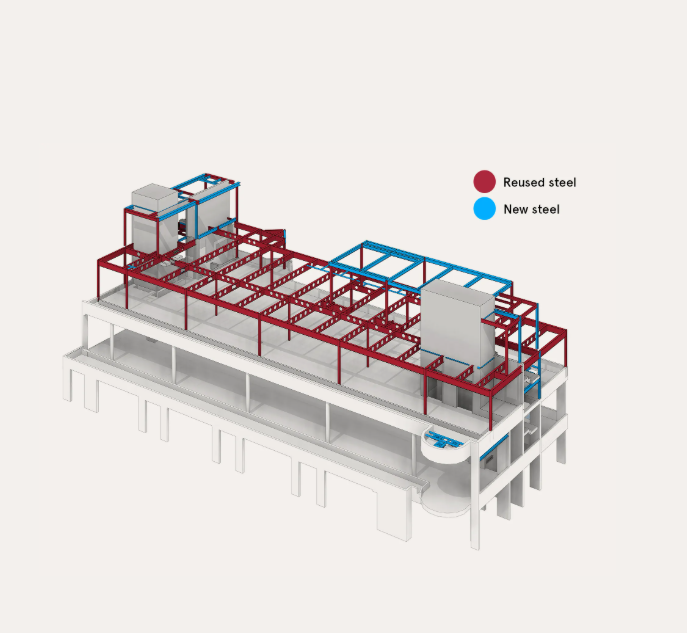
Our most successful examples of steel reuse are those where we have done things simply, using our Stockmatcher tool at stages 3/4/5 and liaising directly with steel fabricators to source the appropriate steelwork. While this doesn’t always maximise the amount of reuse, it ensures that it’s achieved without impacting programme, procurement and cost. Aside from reducing the embodied carbon of the project, from the client’s perspective there is no noticeable difference compared to using traditional steel.
We have designed buildings with reuse as the main low carbon driver, maximising the proportion of reuse by using donor buildings or talking directly to suppliers early on in design. This works, but it is hard work, with considerable impact on design and procurement as well as potentially affecting programme and cost, as it ultimately over-complicates things.
“Steel reuse needs to be integral to the industry, with deconstruction specified to identify and extract the right types of steel and minimise waste. We need suppliers primed to take the steel and prepare it ready for refabrication, and a design process that allows all engineers and steel subcontractors to easily substitute traditional steel for the available reused sections.”
Tom Steel, Director, Heyne Tillett Steel
Looking to the future
We don’t see this as the future of this market. There is a limited supply of reclaimed steel of suitable quality for effective reuse. Why try and cram all of this into a few buildings when instead we could share the supply across a wider range of projects and simplify the process? Steel reuse needs to be integral to the industry, with deconstruction specified to identify and extract the right types of steel and minimise waste. We need suppliers primed to take the steel and prepare it ready for refabrication and a design process that allows all engineers and steel subcontractors to easily substitute traditional steel for the available reused sections.
One notable event was the exit of EMR (European Metal Recycling) from the market in the early part of 2025. This leaves just one supplier of reused steel currently active in the market; Cleveland Steel & Tubes. We spoke to Roy Fishwick, Managing Director of Cleveland Steel, to get his insight on the current market for reused steel.
“Margins on reused steel are tightening due to the falling price of new steel, which is currently 50% lower than a year ago, as well as the intensive manual processing required to clean up reclaimed steel and prepare it for reuse. We are trying to get better fit between our available material and the project to minimise these costs.
We also try to balance this by working closely with design teams to reduce unexpected delays and last-minute design changes, which could otherwise derail steel reuse on a project.”
Roy Fishwick, Managing Director, Cleveland Steel & Tubes
Today, Cleveland Steel has over 7000 tonnes of reclaimed steel available for reuse, ready to be specified on projects, including much of the best steel acquired from EMR when they ceased their reused steel offering. So let’s start specifying more buildings to be deconstructed with reuse in mind, liaise with Cleveland Steel on supply, and make use of open-source tools like the HTS Stockmatcher to rapidly match suitable reused sections with our design requirements.
The more we all embrace this process and embed it into the industry, the sooner it will become second nature, no longer an exception but the norm.
We co-wrote a Deconstruction Specification for the Engineers Reuse Collective, providing guidance on deconstruction for reuse, available to all ERC members at the link below.