Material Efficiency as a Key Opportunity to Reduce Embodied Carbon in Structural Systems: Data Insights from 226 Fully Designed Projects
In this paper, a data set of material and emissions quantities in 226 fully designed structural systems of buildings engineered by the firm Thornton Tomasetti is analyzed. The data set contains embodied carbon data granular to structural components (floors, framing, walls, columns, and foundations) and type of structural system (steel or reinforced concrete). The data set is part of a firmwide, and later industrywide, effort to track project emissions but had not yet been analyzed on a quantities-to-emissions basis.
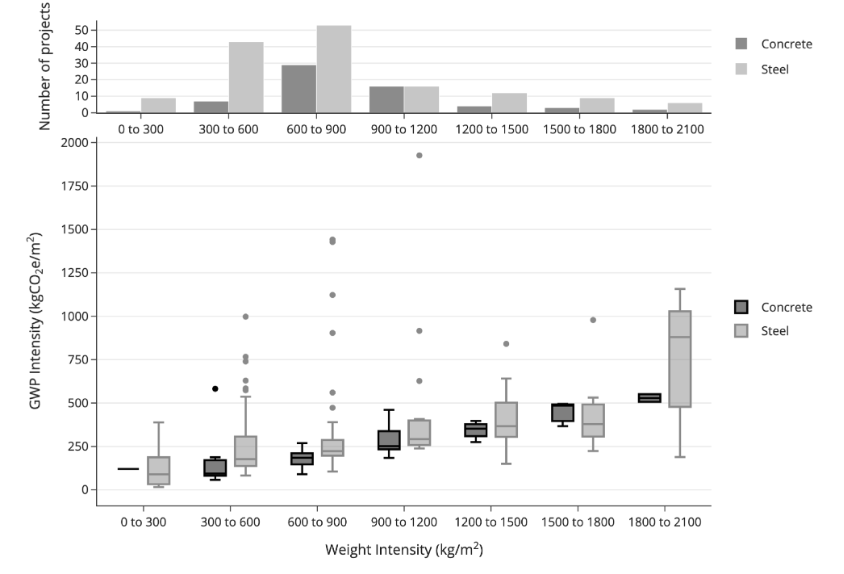
The data offer unique opportunities to answer key questions about (1) the relative contributions of structural components to emissions, (2) the relationship between material system choice and resulting quantities, and (3) the relationship between material quantities and embodied carbon. Although such analyses have been performed for synthetic data, these types of findings are novel for large quantities of late-stage design data on structural systems. The findings are compared with recently published synthetic data from the literature, highlighting the importance of coordinating synthetic data efforts with real late-stage design data. In this data set, foundations make up at least a quarter of a structural system’s emissions, and floors contribute to half of superstructure emissions—the highest average contribution of all superstructure components.
The large variability of relative contributions of floors and foundations to emissions across the data set suggest that floors and foundations are particular opportunities for embodied carbon reduction within structural design conventions represented by the firm’s data set. Under the assumed material carbon coefficients, the analyses suggest that using less structural material could be more likely to reduce emissions than choosing between concrete and steel construction types. As structural engineering firms expand their efforts to track project quantities, this analysis framework demonstrates valuable outcomes of such data efforts, such as the ability to compare the relative importance of material efficiency with material system selection during design. Limitations and challenges for firms to take note of during the data collection effort are also highlighted.