Defining new approaches for retrofit life cycle analysis to improve design outcomes
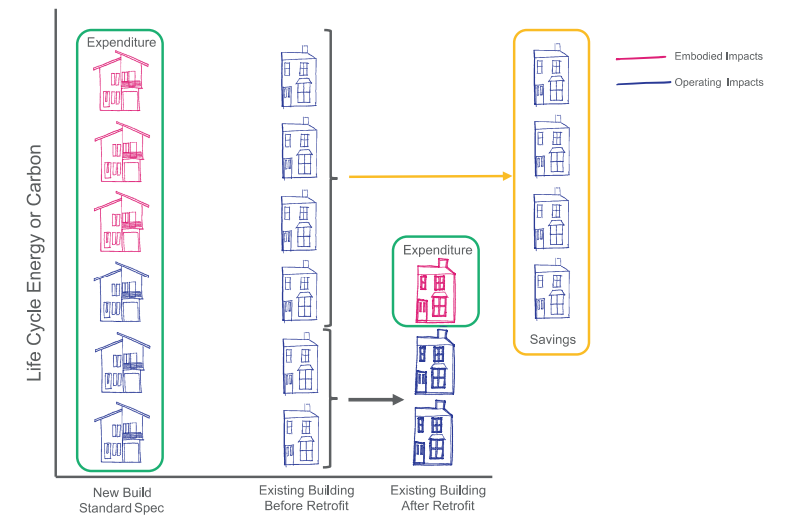
Domestic retrofit is well established as a means of reducing energy consumption in buildings and therefore mitigating climate change. However when life cycle carbon, i.e. carbon impacts associated with the retrofit materials is considered, the life cycle carbon benefit remains under-developed. Wider uptake of retrofit life cycle analysis (LCA) at the design stage would ensure that maximum energy and carbon efficiencies are being achieved both at an individual building and a global scale. Yet robust guidance for retrofit LCA does not exist, and so any LCA delivered at present is subject to much interpretation by the analyst.
This paper considers the well-regarded guidance ’Whole life carbon assessment for the built environment, 2nd edition’ [1], and evaluates its usefulness to retrofit LCA. The research presented here finds that a more specific approach for life cycle carbon and energy analysis of retrofit is required. The RICS approach addresses only carbon analysis and so can easily overlook the advantages of energy demand reductions; many of the default values are unsuitable for a small-scale project like a domestic retrofit; and the method for deriving uncertainty could provide false confidence to users. Instead, to ensure that life cycle analysis outcomes can be pinpointed to retrofit measures with minimal conflating factors, carefully considered deviations and amendments are proposed.
This specificity ensures that results can be used to hone a retrofit design, leading to better life cycle design decision making, facilitate development of a high quality retrofit life cycle dataset, build confidence in understanding retrofit life cycle general trends, enable better strategic and policy level decisions, and importantly, reduce life cycle carbon and energy impacts of retrofit. Ultimately, the redefined LCA approach proposed in this paper, specifically for retrofit, with parameters focused on thermal performance, lays the foundations for a new standard for retrofit life cycle studies.