An LCA Mapping of Off-Site Biodiversity Impacts for 107 Newly Constructed Buildings
In 2024, the World Economic Forum identified the loss of biodiversity and ecosystem collapse as one of the top three global risks to society. The average size of monitored wildlife populations has shrunk by 73% since 1970. While climate change has been the primary focus of the construction sector, it is crucial to recognize that the biodiversity crisis is equally pressing. The construction industry, characterized by substantial energy and material consumption, significantly contributes to a large share of the impact of climate change and biodiversity losses.
This study utilizes an automated and refined version of the Doughnut Biotool to comprehensively map and analyse the off-site biodiversity impact of 107 projects from Sweco Denmark’s Life Cycle Assessment database. Since the dataset is based on Danish construction, the buildings’ layout and material composition represent typical new construction in northern Europe. The study’s findings reveal significant burden-shifting associated with transitioning to a more wood-based construction industry. While increasing the use of wood effectively lowers the Global Warming Potential, it concurrently elevates the impact on off-site biodiversity. Furthermore, the study identifies which building components and material types that impact biodiversity the most. By adopting a more holistic approach that encompasses both Global Warming Potential and biodiversity impact, the construction industry can achieve a more comprehensive understanding of its environmental impact, which is essential for making informed decisions.
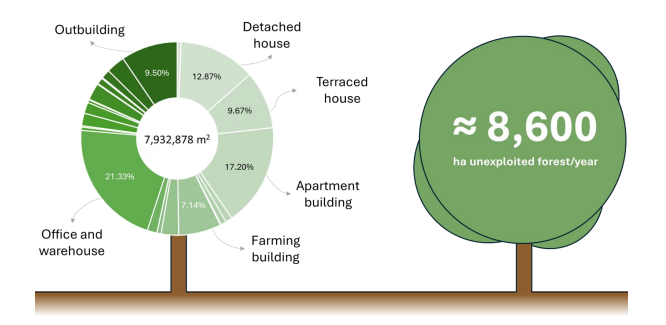
The study investigates the off-site biodiversity impact of 11 building typologies and eight structural concepts, laying the groundwork for future construction practices with a lower biodiversity impact. The scientific novelty of the study is primarily the broad mapping of an extensive dataset of new construction and the automation of the calculation for off-site biodiversity impact.