A top-down approach in developing embodied carbon caps: Case study of the Irish residential sector
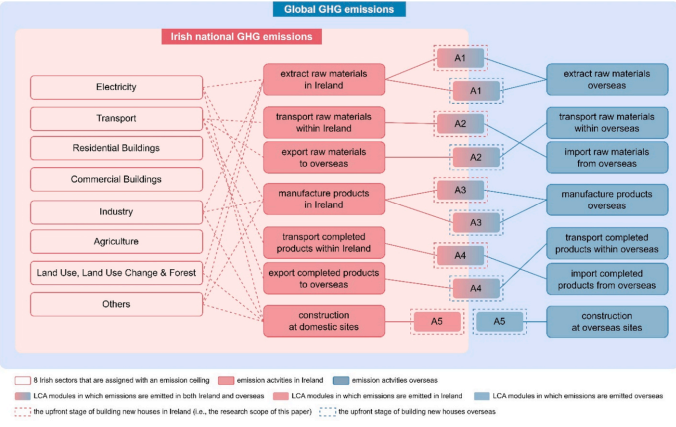
Ireland’s built environment contributes approximately 37 % to national greenhouse gas (GHG) emissions, with a 3:2 ratio from the residential to non-residential sector. A series of measures, including regulation changes and energy retrofit grants, mean that operational GHG emissions are expected to decrease, whereas the disclosure and cap requirements for upstream GHG emissions, or “embodied carbon” (EC), are still under development. With some nations worldwide already regulating and restricting EC from building projects, a broadly applicable top-down approach is proposed to develop upfront EC caps for new housing construction in Ireland.
The top-down approach applies two methods, grandfathering and utility-principle, to allocate national carbon budgets to the upfront stage of new houses. For countries without national carbon budgets, suggestions are given for determining and downscaling the global carbon budget to national levels. In comparison, the generated caps from two methods show similar average values.
The grandfathering method suggests 292 and 194 kg CO2eq/m2 for 2024–2025 and 2026–2030, respectively, while 284 and 188 kg CO2eq/m2 are suggested by the utility-principle method for the same periods respectively. However, the utility-principle method generates larger uncertainty than the grandfathering method due to a more pronounced response to the 2008 global financial crisis. Following the potential investigation of some strategies to meet the proposed caps, it is found that efficient compliance with the caps necessitates implementation of multiple strategies. Finally, despite some uncertainty, the proposed caps underscore the critical imperative of reducing upfront EC in the Irish residential sector. Current challenges associated with implementing EC mitigation strategies are also highlighted.