Design + Make: How a Woodland Campus Is Shaping the Future of Low‑Carbon Timber Architecture
News Detail
Deep in the Dorset woodland, the Architectural Association’s Design + Make programme is quietly reshaping the conversation around sustainable construction. Operating from the AA’s Hooke Park campus, the initiative has become a rare example of architectural education that not only teaches low‑carbon design but actively builds it—at full scale, with locally sourced timber, and with a research agenda that directly engages with the climate challenges facing the construction industry.
A Forest as a Classroom
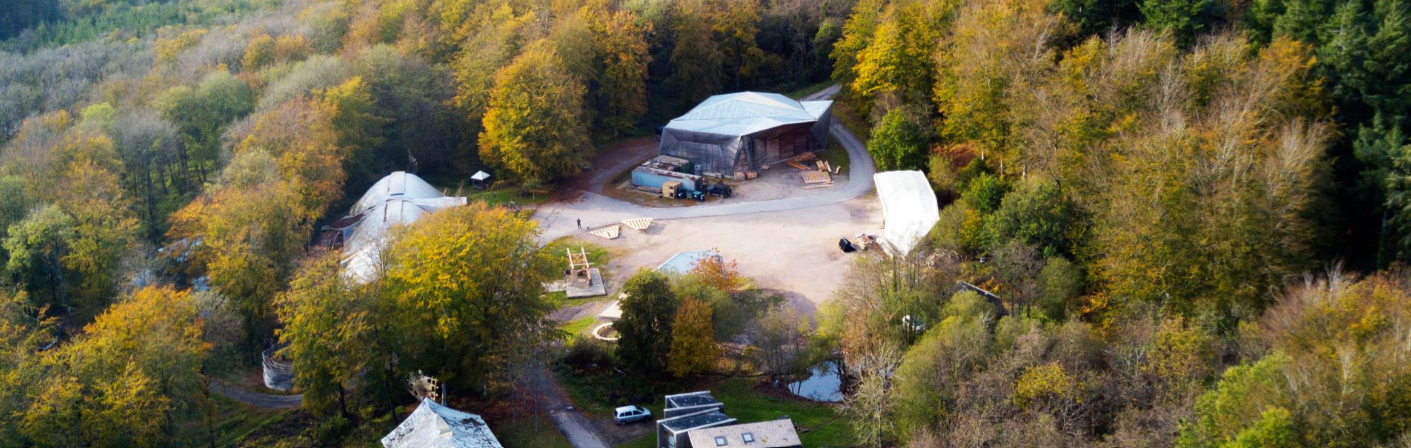
Hooke Park’s 150‑hectare woodland is more than a backdrop; it is the programme’s primary material library. Students work with timber harvested directly from the forest, learning to understand its growth patterns, structural behaviour, and ecological value. This relationship with the landscape encourages a design approach grounded in stewardship rather than extraction.
Instead of relying on industrially standardised materials, students engage with the irregularities and natural geometries of roundwood, forks, and non‑linear timber. This shift in mindset—from controlling material to collaborating with it—is central to the programme’s ethos and central to the broader movement toward regenerative design.
Building Through Research
What sets Design + Make apart is its commitment to learning through building. Each year, students design and construct full‑scale structures that become permanent or semi‑permanent additions to the Hooke Park campus. These projects serve as both architectural experiments and working prototypes for future low‑carbon construction.
Among the programme’s landmark achievements is the Big Shed, a large-span workshop building that demonstrated how low‑grade, locally sourced timber could be used to create a robust, expressive structure. Its success helped establish Hooke Park as a proving ground for unconventional timber applications.
The Wood Chip Barn followed, exploring steam-bent timber techniques to create a lightweight enclosure for biomass storage. This project exemplified the programme’s interest in combining traditional craft with contemporary digital workflows.
The West Workshop pushed the research further, using computational design to optimise the use of irregular tree forks as structural nodes—a technique that transforms what is typically considered waste wood into high-performance architecture.
More recent projects continue to expand the programme’s ambitions. The Refectory Extension uses robotic fabrication to process naturally curved timber elements, creating a structurally efficient and visually striking dining space. The Caretaker’s House investigates how roundwood and digital fabrication can be combined to produce a low‑carbon dwelling with minimal material waste. Even smaller interventions, such as the Boathouse, Timber Seasoning Shelter, and Woodland Classrooms, contribute to a growing catalogue of experimental timber structures that collectively form a living archive of sustainable design research.
Where Craft, Computation, and Ecology Converge
Design + Make operates at the intersection of traditional craft knowledge and advanced digital fabrication. Students use 3D scanning, generative modelling, and robotic milling not as ends in themselves but as tools to better understand and work with the complexities of natural timber.
This hybrid approach creates a feedback loop between design and making: prototypes inform digital models, which in turn guide fabrication strategies, which then reveal new material behaviours. The result is architecture that is both technologically sophisticated and deeply rooted in ecological intelligence.
A Blueprint for Regenerative Architectural Education
As the construction industry confronts the urgent need to reduce carbon emissions, Design + Make offers a compelling model for how architectural education can lead the transition. By grounding innovation in hands‑on experimentation with local, renewable materials, the programme demonstrates that sustainable design is not an abstract ambition but a practice that can be built, tested, and refined.
Hooke Park continues to evolve as a living laboratory—a place where forests, fabrication, and architectural imagination converge to explore what a genuinely low‑carbon future might look like. For the students who pass through it, the experience reshapes not only how they design but also how they understand their responsibility as architects in a rapidly changing world.
Photo: Hooke Park, The Architectural Association’s woodland campus in Dorset, UK. Source: AA website.