Event on the sustainability of natural materials for construction to mark COP30
News Detail

Year:
2025
Source:
UWE BristolBy Freya Wise, Alice Moncaster, Hector Archila and Tavs Jorgensen
On the 3rd of December Caber ran an action-packed hybrid event to mark COP30. After a short introduction reflecting on the COP30 outcomes we then had excellent presentations on three natural building materials which UWE researchers are involved with: bamboo, cob and timber. This blog reports the highlights of the session for a wider audience.
Reflection on COP30 by Dr Freya Wise
The reflection on COP30 by Freya highlighted that the overall outcomes were felt to be disappointing and lacked ambition but were not as bad as they could have been and that a range of useful things were achieved. It will be interesting to see if taking forward the fossil fuel and deforestation roadmaps outside the official COP process will actually allow them to be more ambitious and progress more quickly with willing countries.
Concerns were highlighted around a lack of acknowledgement of the latest climate science from the IPCC in the final document and the dropping of language on the need to fight misinformation. From a positive perspective however this was the first COP for several years in a countries where mass protests are possible and had strong civil society and cultural engagement around the city of Belem, including from high numbers of indigenous people.
Specifically on the built environment, Freya identified a number of initiatives, guides and standards were launched at COP which have positive relevance. These included the Belém health action plan, United Nations Environment Programme (UNEP), ‘Beat the Heat’ initiative, and the Bélem ‘call for action for sustainable and affordable housing’ as well as initiatives on circularity and low carbon materials. If these are enacted, they will have positive implications for decarbonising the built environment and links to all can be seen at the end of the article.
Following on from some of the initiatives at COP around low carbon and biobased materials, we then had three engaging short talks on three different natural materials.
The benefits of Bamboo by Dr Hector Archila
Hector took inspiration for his talk from the ‘BambooBoost Initiative’ from the UN Framework Convention on Climate Change (UNFCC) and the International Network for Bamboo and Rattan (INBAR).
Hector explained that bamboo is a very sustainable material with rapid biomass production which translates to a high yield and excellent CO2 sequestration in both the biomass and the soil. Bamboo, which is actually a grass, is one of the fastest-growing ‘woody’ plants and thrives on degraded land. Over fifty years a tropical bamboo species produces between 5 and 8 times more biomass than Scots Pine and Oak, resulting in 5 to 8 times as much carbon sequestration as those trees over the same period.
Hector highlighted that, according to UNFCC, if bamboo were cultivated on around 70-174 million hectares of degraded forestland it could sequester roughly 2 Gt of CO2 annually (for reference Spain and Portugal combined are cover about 68 million hectares). This would equate to 2% of current global greenhouse gas emissions and would also deliver significant net economic benefits. In terms of climate action, it therefore makes a lot of sense to plant bamboo forests which will produce carbon and fibre rich biomass in 4–6-year periods which can then be used in long-lived products to act as carbon stores.
In terms of biodiversity enhancements, Hector suggested that if more bamboo was planted less wood forest would need to be used thus reducing deforestation and providing ecosystem services. Bamboo forests themselves also have good biodiversity with a plethora of animal species. Bamboo can provide ecosystem and community resilience for the many people who rely on solid biomass for cooking such as charcoal or briquettes, with fast growing highly renewable biomass. Bamboo can also be converted to gas or pellets to provide a source of electricity and heating, thus reducing deforestation and use of fossil fuels
Finally, research at UWE by Hector on the project SmartBioC has shown how Biobased Building Systems for UK housing using engineered bamboo as the main structural component can provide better Natural, Human and Social benefits than traditional building systems used in the UK.
Innovative earth building research at UWE by Dr Tavs Jorgensen
Tavs provided an introduction to cob or earth as a local, low carbon building material with a long history of use and increased research interest in recent decades. However, challenges were also highlighted with traditional cob construction around the thicknesses required to meet insulation levels in modern building regulations and the length of time that building traditional cob walls requires.
Tavs then discussed the research that he has been leading at UWE to investigate how to use 3D printing processes to make dies to extrude cob bricks in different shapes, which has the potential to substantially speed up the production process while allowing creativity in the creation of different brick shapes and forms.
Work has taken place to engage students in this research through competitions and a ‘Cob Club’ as well as a number of wider hands-on workshops exploring the qualities of different earth and the potential of the material. A ‘Cob Comp’ (cob competition) in 2024 enabled UWE students to explore extruded cob block technology and the winners’ ideas were used to successfully build a shelter on the University grounds.
Tavs also took the opportunity to launch this year’s iteration of the competition, Cob Comp 2: Earthly Enquiries. This is an ideas competition to design a structure built from pressed earth brick units of students’ own ingenious designs and from materials found only within the boundaries of UWE’s Frenchay Campus. The competition aims to explore the structural capacities and concepts of making and building with compressed earth. There are plans to build the winning design in summer 2026.
Tavs therefore highlighted both the benefits of innovative methods for cob and the importance of engaging students in hands-on research and creativity.
Sustainable timber and biogenic carbon standards by Professor Alice Moncaster
Alice highlighted the new principles for Sustainable Timber Construction and which were officially launched at COP30 (see link below). Alice then went on to give a quick introduction to lifecycle assessment (LCA) which measures the carbon emissions associated with the whole life of a material including its extraction, manufacture, transport, installation, maintenance and end of life disposal.
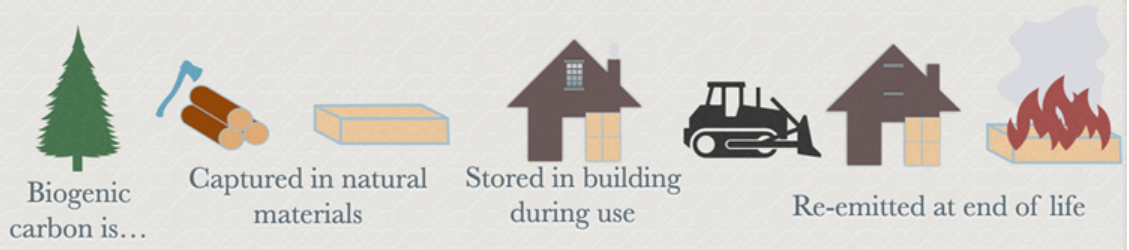
She then discussed how the biogenic carbon stored in natural materials (and then released back into the atmosphere at the end of the of the material’s lifespan), is treated in a range of national and international standards on whole life carbon reporting. Biogenic carbon storage is one of the key benefits of natural materials and is particularly valuable in buildings as they theoretically last a long time, thus storing carbon for many decades (but not permanently). For a full LCA, the biogenic storage in phases A1-A3 is then reemitted in phase C, while most standards currently require that if only upfront carbon is assessed, biogenic carbon is reported separately.
Alice discussed multiple standards and reported on discussions at a recent meeting of International Energy Agency (IEA) Energy in Buildings and Communities (EBC) Annex 89, ‘Ways to implement net-zero whole life carbon buildings’. Climate science says that biogenic carbon is not equivalent to fossil carbon and cannot be added together. The discussions therefore focussed on whether biogenic carbon should be reported separately throughout all LCAs. This does not mean that the biogenic storage of natural materials is not useful and positive but does highlight that it is not a simple silver bullet and cautions against some of the evangelical calls for over-building with timber as a form of carbon removal from the atmosphere.
Alice therefore opened the discussion and posed some questions on how we should be reporting sustainable timber use for everyone to consider.
More info